A couple of weeks back we had a small cake in the workshop. It was for the twentieth car. We don't tend to keep a running tally on the whiteboard, but every car gets a build plaque before it leaves us, and that one had the number twenty stamped on it. Twenty cars, five years, seventeen more on the floor. Easy to miss when you're busy building the next one.
Then Dylan Campbell from Drive wrote a story about us. If you haven't read it, the headline is a fair summary: the Aussie car maker trolling Tesla with electric 1960s Minis. The comment thread under it ran hot. Forty-five comments, some of them from people who loved the idea, some from people who thought we were committing light arson on the national automotive heritage.
So Drive did what Drive does. They ran a poll.
What 1,943 people said
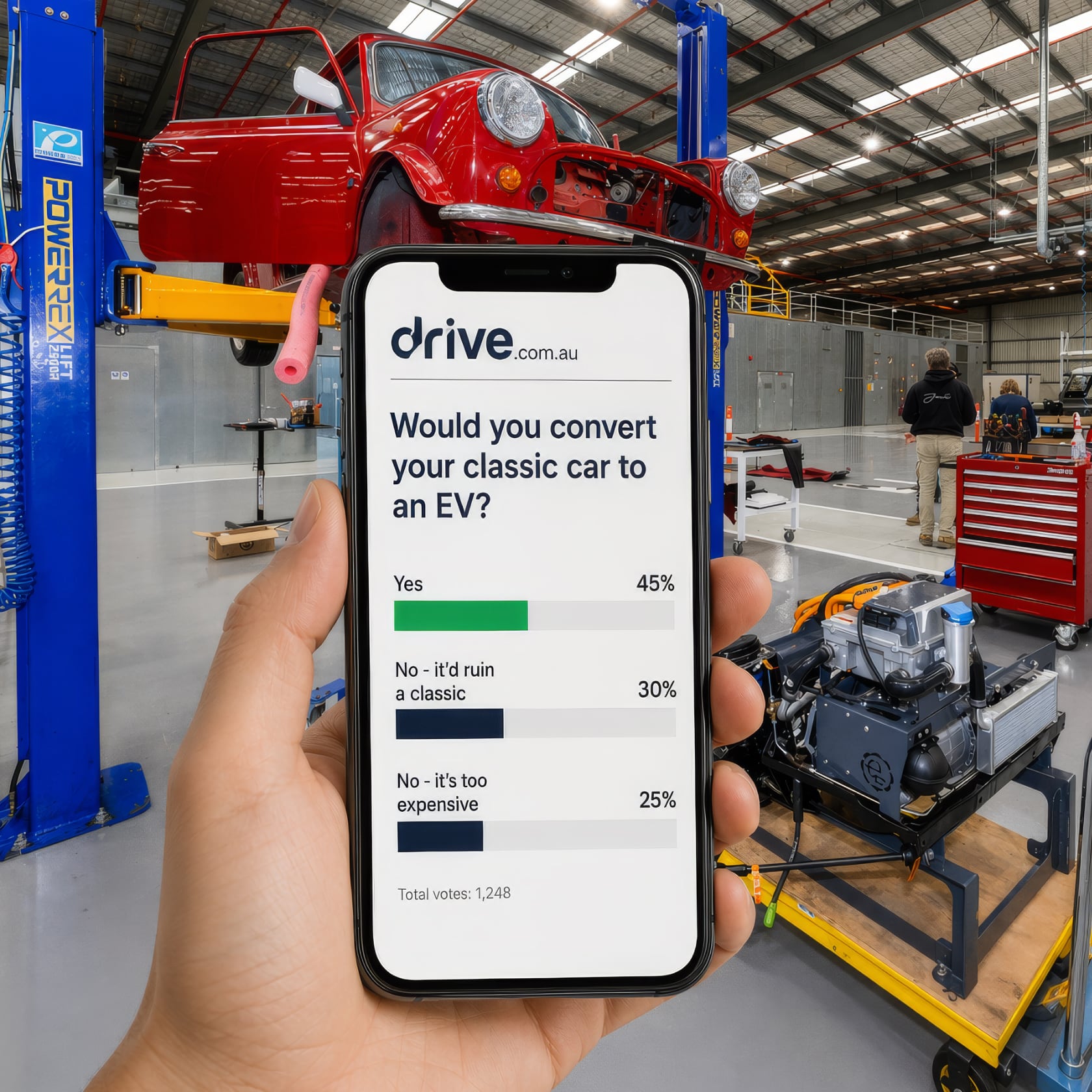
Jemimah Clegg's follow-up piece ran a week later. The question was simple: would you spend $200,000 or more to convert a classic to electric? Nearly two thousand Drive readers voted. Here's what came back.
Forty-five per cent said yes. They'd do it to preserve the car for the next generation.
Thirty per cent said no, because converting the car would ruin its authenticity and value.
Twenty-five per cent said no, because the price was too much.
We've been quietly making this case since late 2018. It still felt a bit surreal to watch a national motoring publication run the numbers and have almost half of their audience say yes. For anyone who's had the "but it's sacrilege" conversation at a barbecue (and if you own a Jaunt, you have), that stat is going to land differently.
The comment that stopped us
One of the comments on Jemimah's piece captured something we've struggled to say well for years. We'll just quote it:
"For everyone who complains about ruining a good old car. Take a look around and see how many old ICE Minis and Land Rovers you actually see driving around, and think again about how many old cars you see rusting away on rural properties. Jaunt is future-proofing the best parts of these cars that always had underpowered engines that make them un-drivable in modern road conditions, and making them daily drivers where everyone can see and admire some auto history."
That's the real choice. Not "original versus electric". It's "driven versus rusting". A classic that doesn't get driven isn't a classic, it's an object.
One of our customers keeps a Kombi at a beach house in Lorne. Before we rebuilt it, it sat in a shed most of the year because the original brakes and the original engine and all the hills in town weren't a combination you'd trust three kids and a dog on. It now does those trips constantly. Three generations of the family drive it. That's the point. Not the powertrain. Use.
The sceptical voices, honestly
The other side of the survey had good points too. We're not going to pretend otherwise.
The authenticity concern is real. If you think of a classic car as a historical artefact, replacing the drivetrain feels like overpainting an oil painting. We don't fight that view when we hear it. We just don't share it. Our position has always been that a car is a thing you use, and the thing that makes an old Land Rover feel like an old Land Rover isn't the engine, it's the aluminium body, the boxy silhouette, the gear lever position, the way it sits on a dirt road. We leave all of that. What we replace is the part that's stopping you using the car.
The price concern is real too. Two hundred thousand dollars plus a donor car isn't a casual purchase. One of the Drive commenters wrote, quite reasonably, "there will be others who will enter this industry. That will ensure the price comes down over time." We agree. There are maybe twenty operations in the world doing what we do at a similar standard, and that's nowhere near enough to serve the market this survey suggests exists. We'd welcome more of them. A bigger industry is a better industry.
Where that leaves us
When we started Jaunt at the end of 2018, Marteen and I spent most of our time in any given conversation explaining what we were and why we were doing it. The idea that you could pull a spluttering old engine out of a 1958 Land Rover and put a modern electric drivetrain in without ruining the car was, to most people, novel. To some, offensive.
Seven years on, the country's biggest motoring publication ran a poll asking essentially the same question, and almost half the voters said yes. Twenty cars out the workshop door. Seventeen on the floor right now. The conversation has shifted from "why would you do that?" to "how do I get one?"
We don't think the argument is settled. A third of people still think it's the wrong idea, and they're entitled to think so. But when you add up the yes camp, the "too expensive" camp (which is really a yes camp with a budget problem), and strip it back to people who just philosophically disagree, you're left with something closer to a third of drivers than half. The sacrilege argument is losing its centre of gravity.
That's what we took from the Drive piece. Not vindication. Just a sense that the thing we've been building slowly, car by car, is something more people want than we'd have guessed five years ago.