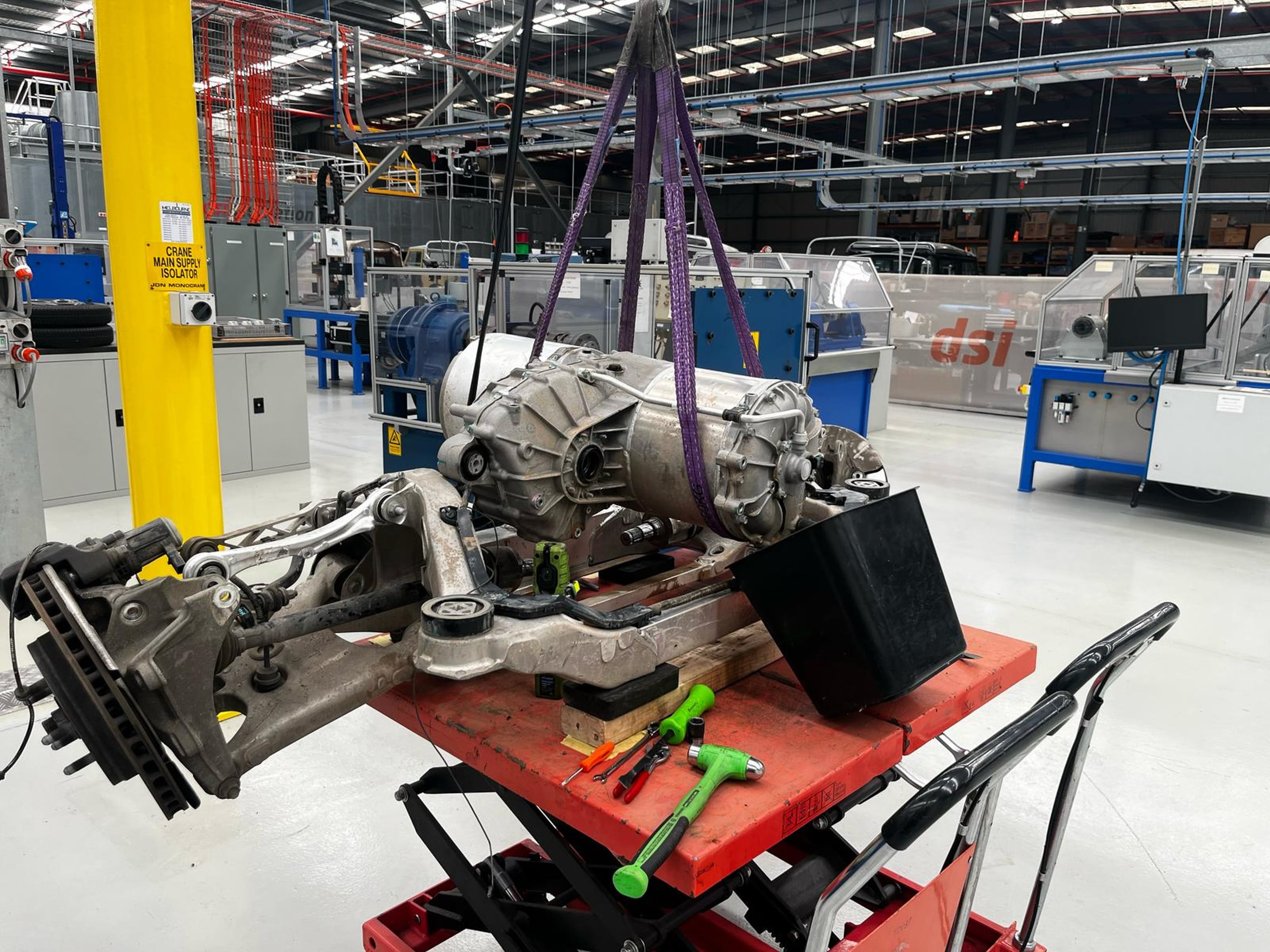
If you'd told me five years ago that Jaunt would be servicing Teslas, I'd have laughed. We don't work on new cars.
But here we are. And there's a reason.
How we knew about it
The Tesla Large Drive Unit is a very good motor. Compact, powerful, well-engineered. For a while, we used them in some of our own conversions — drop a rebuilt LDU into a Land Rover and you've got serious capability without having to design a whole new drivetrain from scratch.
Before we use any part in a Jaunt-built vehicle, we do the research. Every bolt, every seal, every piece of silicon. We want to know what it's rated for, how it ages, what the known failure modes are, and what it takes to fix them when they come up. That's non-negotiable for us — these are cars that have to last decades, and we're the ones on the hook if they don't.
When we looked at the LDU, the rotor seal issue was sitting there in the service data and the teardowns. Three small rubber lip seals inside the rotor shaft, keeping coolant inside a passage that runs through the spinning centre of the motor. They don't last. Not “might not last” — won't last. It's material science, not bad luck. Heat cycles and age will get them in the end.
When they give up, coolant leaks into places coolant should never be. It wicks into the stator windings. It corrodes connectors. It turns bearing grease into slurry. And most of the damage happens silently. You might get a whining noise or a limp-mode warning, or you might get nothing at all for months, and then the motor just stops.
Tesla knew about it too. The later drive units removed the rotor coolant path entirely. But that leaves a whole generation of Model S and Model X owners driving around with the original design, waiting for something they can't see.
From our builds to a service
So we built the fix into our own process from the start. Any LDU going into a Jaunt car got the coolant delete as part of the rebuild — not because it had failed, but because we weren't going to wait for it to. Tesla's later revision showed exactly what needed to happen. We worked out how to do it cleanly on the older units, using the machine shop and the precision tooling we already had.
Once we had the method dialled in, Model S and Model X owners started asking whether we could do the same thing on their cars. At first it was word of mouth — a few people we knew who'd been quoted $15,000 to $20,000 for a full drive unit replacement. Then a few more. And it became clear we were the only workshop in Australia doing this as a proper, full-service fix.
Our workshop is set up for it. We've got a full machine shop. We've spent eight years building high-voltage drivetrains from scratch. Opening up a Tesla motor and putting it back together properly isn't that different, in principle, to what we do every day.
So we decided to offer it properly.
What we actually do
We take the Large Drive Unit out of the car and strip it completely. Every component comes off, gets inspected, gets catalogued. We need to see everything before we touch anything — because if coolant has already reached the motor cavity, we want to know exactly what shape it's in.
Then we clean it. Carefully. No wire brushes on critical surfaces, no shortcuts that leave debris where it shouldn't be.
The actual fix is the bit that takes precision tooling. The coolant delivery tube gets milled and capped with a machined manifold, sealed with high-temperature sealant. That permanently eliminates the rotor coolant path — matching the manufacturer's own revised design. Gearbox cooling is unaffected and keeps flowing the way it should.
While we're in there, we replace both half-shaft seals — they're a secondary leak path that gets overlooked constantly. We check the rotor for runout and contamination damage. We assess the bearings. If we find something we weren't expecting, we ring you before we do anything about it.
Then it all goes back together to factory spec. Every single-use bolt replaced with a new one. Every fastener torqued to the exact spec — not “close enough”, exact.
Two to three business days, start to finish. $5,499 including GST. If the car's over eight years old or we're worried about the rest of the cooling system, we'll usually recommend a full system flush on top, which is another $1,099. We'll tell you honestly whether you need it.
The honest version
Here's the thing I want to be straight about: if coolant has already done damage inside your motor before you bring it to us, we can't undo that. The windings are what they are. Contamination that's reached the wrong places has reached the wrong places. What we can do is stop it getting worse, fix the root cause, and tell you exactly what we found.
That's why, if you're reading this and you own a 2012–2020 Model S or X with the original drive unit, I'd genuinely encourage you to get it done before you need it. Preventative is always the best outcome for this one. The service is the same whether you've got symptoms or not — and the earlier you catch it, the more of the motor you get to keep.
Why it fits
We're still a classic car workshop. We're still building hand-made electric Land Rovers and Minis and Mokes, and that's still the main game. But the reason Jaunt exists is that we think the skills to keep EVs running for decades should exist everywhere — not locked up inside one manufacturer's service network.
Fixing a systemic issue on a popular EV, with parts and precision that aren't available anywhere else in Australia, feels like exactly the kind of work we should be doing. It keeps good cars on the road. It saves people from a $20,000 bill that didn't need to happen. And honestly, it's interesting work, and we like interesting work.
If you've got a Model S or Model X and you want to know more, the service page has the detail. Or just get in touch — happy to help you figure out whether your car needs it, even if the answer is “not yet”.
Dave